


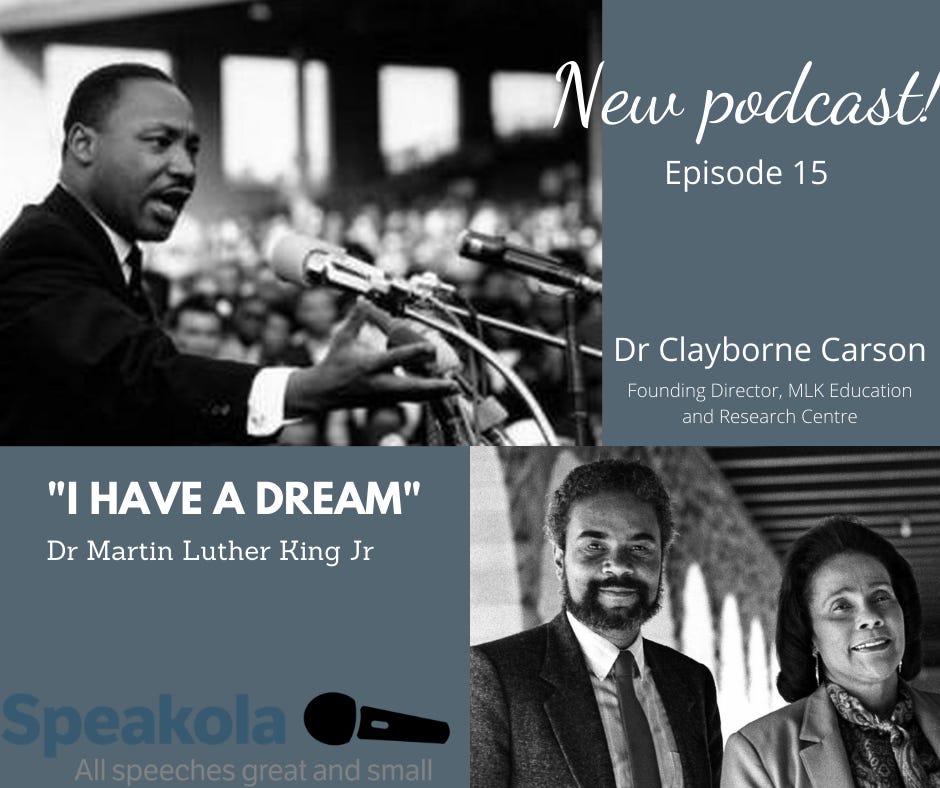
I did a podcast episode about the I Have a Dream speech a few years ago with Dr Clayborne Carson of the King Center, who travelled from New Mexico to Washington to be there in person in 1963, and the experience sparked a lifetime of studying Dr King’s letters and writings.
In the episode he discusses the ‘bad cheque’ metaphor, and the experience speech co-writer Clarence Jones had with the Rockefellers and a $250,000 promissory note. He discusses the legend of Mahalia Jackson and the ‘tell them about the dream’ request in the middle of the speech. He talks about the extraordinary decision by Dr King to put down the written text and extemporise the last half of the speech. He discusses Coretta Scott King, her underrated contribution, and the job she offered him that has occupied nearly all of his professional life. It’s a great episode, and one worth revisiting if you listened to it a few years ago.
Below I’ve compiled some classic speeches of the Civil Rights era, beginning with Dr King’s extrordinary speech in defence of Rosa Parks, at the time of the Montgpomery Bus Boycott.
Martin Luther King’s speech calling for Bus Boycott, Montgomery 1955
We don’t have audio of this one, but it’s a scintillating text. The short video embed at the top of page is MLK talking about the success of the boycott, how ‘only eight Negroes were seen riding the buses that day’. It’s the speech that turned Martin Luther King into a national figure. And this last paragraph is incredible:
“And I won’t rest; I will face intimidation, and everything else, along with these other stalwart fighters for democracy and for citizenship. We don’t mind it, so long as justice comes out of it. And I’ve come to see now that as we struggle for our rights, maybe some of them will have to die. But somebody said, if a man doesn’t have something that he’ll die for, he isn’t fit to live.”
Malcolm X’s ‘It’s the ballot or the bullet’ stump speech, 1964
Malcolm X delivered the most famous version of this speech in Cleveland on 3 April 1964, but the themes and general content were used over an entire campaign. The audio attached is from two weeks later in Detroit. If Martin Luther King found mainstream acceptance as a Christian minister of genius talents, Malcolm X, a Muslim, talking about the ballot or the bullet and black nationalism, also had incredible speaking skills. He spoke with a stridency and combativeness that was never going to have the same pan America appeal - but it stands up as one of the speeches of all time.
“The political philosophy of black nationalism only means that the black man should control the politics and the politicians in his own community. The time when white people can come in our community and get us to vote for them so that they can be our political leaders and tell us what to do and what not to do is long gone.”
John Lewis, March on Washington, ‘We want our freedom and we want it now’, 1963
Delivered the same day as ‘I Have a Dream’, it is the speech that Clayborne Carson best remembered from the day. Lewis was still in his mid twenties, and the speech combines some of the themes of Dr King’s speech, with considerable flourish and more specific frustration regarding inactivity in Congress and with arrests around the nation.
“ As it stands now, the voting section of this bill will not help the thousands of black people who want to vote. It will not help the citizens of Mississippi, of Alabama and Georgia, who are qualified to vote, but lack a sixth-grade education. “One man, one vote” is the African cry. It is ours too. It must be ours! “
Shirley Chisholm’s campaign speech, 1972 Presidential run, UCLA
Shirley Chisholm’s legendary speech at the reading of the ‘Equal Rights for Women Bill‘ cemented her place in history, as much a champion of feminist causes as the civil rights movement. She was the first African American woman elected to Congress, and she ran for President in 1972. Her voice is so compelling, I’ve put a snippet in theme song to the podcast, and she is utterly fearless. A pioneer, and one of the greatest orators of all time.
“ It has been observed before, that society for a long time, discriminated against another minority, the blacks, on the same basis - that they were different and inferior. The happy little homemaker and the contented “old darkey” on the plantation were both produced by prejudice. “
Dr Martin Luther King’s ‘A Time to Break Silence’ speech opposing Vietnam, 1967
As Dr Carson says in the podcast, this is a much more controversial and divisive speech than ‘I Have a Dream’. it’s much longer, and is expressed as an argumentative essay on why Dr King opposes involvement in the Vietnam War. The themes are picked up by his widow Coretta, just after his assassination, when she gave Dr King’s ‘Ten Commandments on Vietnam’ which she found in his pocket on the night he died.
“Since I am a preacher by calling, I suppose it is not surprising that I have seven major reasons for bringing Vietnam into the field of my moral vision. There is at the outset a very obvious and almost facile connection between the war in Vietnam and the struggle I and others have been waging in America “
Martin Luther King, Eulogy to children killed in Birmingham church bombing, 1963
Such a moving speech following a horrendous event. On Sundey 15 September 1963 four Klansmen bombed the Sixteenth Street Baptist Church in Birmingham. Four young girls died, and this is the eulogy at the service for three of the victims, Addie Mae Collins, Carol Denise McNair, and Cynthia Diane Wesley. A separate service was held for the fourth victim, Carole Robertson. In the film, ‘I Am MLK Jr’, a civil rights leader said this was the only speech where he saw Dr King shed tears.
“ And so today, you do not walk alone. You gave to this world wonderful children. [moans] They didn’t live long lives, but they lived meaningful lives. (Well) Their lives were distressingly small in quantity, but glowingly large in quality. “
Jesse Jackson, ‘I am Somebody’, Wattstax Music Festival, Los Angeles 1972
Such a dynamic and inspiring speech that has been resampled into rap anthems. Arguably the best example of a call and response speech ever delivered. Jesse Jackson’s 1984 presidential campaign speech is also amazing.
“That is why we’ve gathered today, to celebrate our homecoming and our own sense of somebodyness. That is why I challenge you now to stand together, raise your first together, and engage in our famous black litany. Do it with courage and determination:
I am ...[I am!]
Somebody... [somebody!]”
Martin Luther King’s last speech in Memphis, I Have Been to the Mountaintop’, 1968
Delivered the day before the assassination. Dr King hadn’t intended to speak, but was particularly moved by the crowd and persuaded by the organisers. Without a prepared text, this roams across history, literally attempting to place the civil rights movement and Dr King’s life within the great arc of historical events, and also has the famous ‘If I sneezed’ section relating to the time he was stabbed. At times euphoric, at times melancholic, there is a sense with the tragic benefit of hindsight that Dr King appreciated the danger he was in
“Strangely enough, I would turn to the Almighty, and say, “If you allow me to live just a few years in the second half of the 20th century, I will be happy.” Now that’s a strange statement to make, because the world is all messed up. The nation is sick. Trouble is in the land; confusion all around. That’s a strange statement. But I know, somehow, that only when it is dark enough can you see the stars. And I see God working in this period of the twentieth century in a way that men, in some strange way, are responding.”
Robert Kennedy’s speech announcing death of Martin Luther King, 1968
An incredible speech, one of the speeches of all time. It was written in the hour or so between RFK finding out about the assassination, and the campaign event, and delivered without glancing at notes. The reaction of the crowd, the screaming, is horrible. The Aeschyllus poem is just amazing, and it’s a speech that makes me tear up.
“What we need in the United States is not division; what we need in the United States is not hatred; what we need in the United States is not violence and lawlessness, but is love, and wisdom, and compassion toward one another, and a feeling of justice toward those who still suffer within our country, whether they be white or whether they be black “
If you liked this list, forward it to a friend or just hit the heart below.
Best wishes to all,
Tony Wilson
http://speakola.com
What a stellar roundup of speeches and orators! It might take me a few weeks or months to work my way through these, as I have to ponder & savor each one. These things can't be rushed.
You are doing yeoman's work here. Thank you.